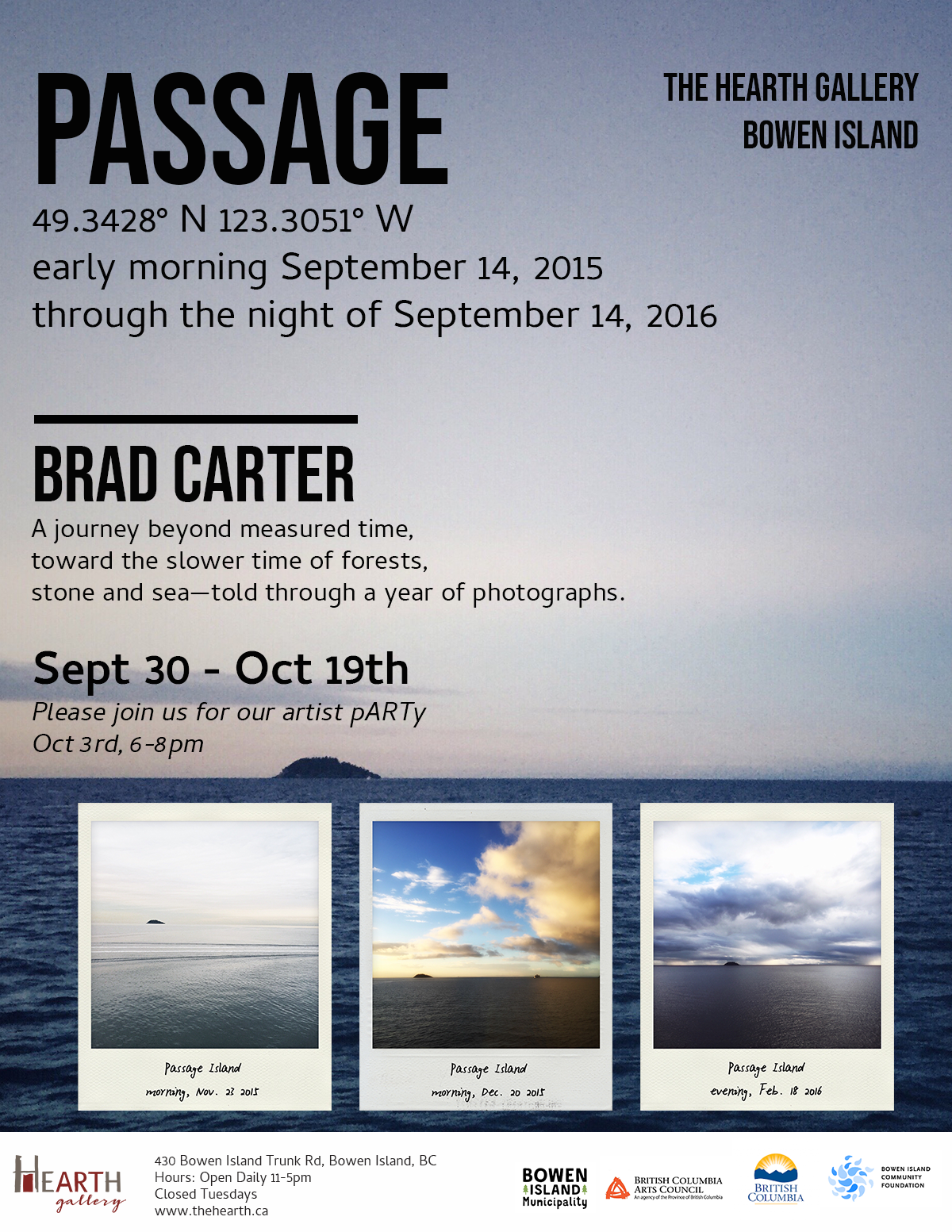
PASSAGE
49.3428° N 123.3051° W
Early morning September 14, 2015
through the night of September 14, 2016
Sept 30th- Oct 19t
A journey beyond measured time, toward the slower time of forests, stone and sea, told through a year of photographs.
ARTIST STATEMENT
Passage Island sits at the entrance to Howe Sound, on the south coast of British Columbia, at 49.3428° N 123.3051° W. It is only accessible by private boat.
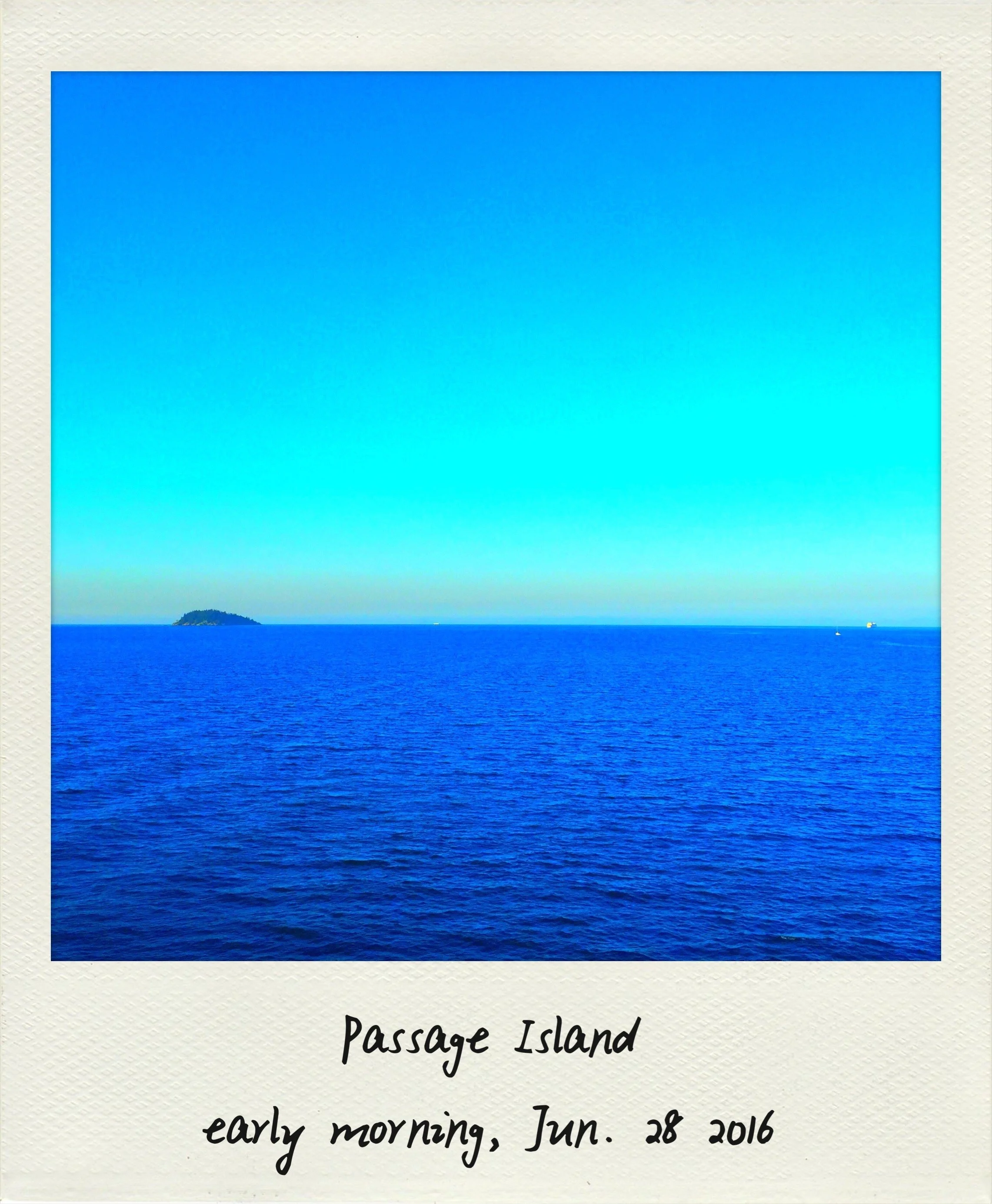
For one whole year I took a photo of Passage Island from the same spot, as near as I could make it, every time I sailed by it as I made the ferry crossing back and forth between Bowen Island, where I live, and the mainland.
Each day of the year is represented by a pair of photos. The top one was taken before midday, the bottom one was taken after. Where there are blank spaces, I did not make the passage across Howe Sound.
I never missed a shot on travel days, though some shots have gone missing. Those are marked with a grey square. A few photos are incorrectly dated, but all the photos are where they should be, in proper sequence.
Although the photos were all taken on an iPhone, they are presented as Polaroids, for the way the slowly developing image pulled from the camera recalls the slowly developing perception of time.
Some images have been edited—not to alter the landscape, but to evoke the experience of a particular crossing or to render the island more impressionistically, reflecting my mood.
The collection of photographs explores the passage of time on three scales.
Together they are something like my personal calendar, giving hints of my daily comings and goings.
In the changing light and colour of the skies from one photo to the next, and the next, and the next, there is also a sense of our long passage around the sun. It was a leap year, incidentally. This orbit seems to be near the limit of human perception of time: a year is hard to grasp all at once but the volume of photographs lined out along the walls here give a sense of it when you step back.
And finally these photos hint at the passage of time for things like trees and rocks and oceans, for Passage Island itself. This kind of time–deep time–appears like a mirage at sea, a projection of something just over the horizon, below the line of sight, not directly perceptible but not entirely beyond sensation either.
I invite you to take your time here. Some things can only be sensed up close: the weather of a single crossing, the lights of a small boat running at night. Other things only emerge from a distance, such as when a wall of days settles into bands of light and dark as the seasons turn or the travel patterns of a commuting man.
Thank you
Brad Carter is an emerging photographer based on Bowen Island, British Columbia. His work explores the relationship between time, place, and perception, often through patient, repeated observation.
His first major project, Passage, is a year-long study of Passage Island in Howe Sound, photographed daily from the ferry crossing between Bowen Island and the mainland. Though the photobook has been complete for some time, this exhibition marks the first time the work is being shown publicly in its entirety.
In 2023, his photograph of a cigarette seller in his booth in Ebisu, Tokyo, was included in the juried exhibition Frame Tokyo. Passage is his first solo exhibition.
ABOUT
ABOUT THE WORK
Passage exists first as a book, a year’s worth of photographs taken of Passage Island from the same vantage point, every time the artist crossed Howe Sound between Bowen Island and the mainland. Each day is represented by a pair of images, one taken before midday and one after, forming a steady rhythm of looking that reveals the subtle and profound shifts of light, weather, and season. Although the photographs were all taken on an iPhone, they are presented in the format of Polaroids, for the way the slowly developing image pulled from the camera recalls the slowly developing perception of Passage Island itself. Some images have been edited—not to alter the landscape, but to evoke the experience of a particular crossing or to render the island more impressionistically. Some
For this exhibition, the pages of the book are unfolded and carried into the gallery. Installed in sequence along the walls, they create a horizontal timeline that encircles the room. Visitors are invited to walk through the year, slowly, step by step, as another way of feeling time: not as something abstract or mechanical, but embodied, immersive, and continuous.